Strategic Foresight (GEO-POWER-EU): Eight Scenarios for the EU candidate-state neighbourhood
This report, prepared by VE Insight as part of the GEO-POWER-EU project, examines how the regional order in the EU candidate-state neighbourhood could develop by 2031. A structured expert elicitation brought together 45 specialists, mostly from universities and think tanks, covering the six Western Balkan candidates, Georgia, Moldova and Ukraine. Participants selected alternative postures for the EU, the USA, Russia, China and Türkiye and used them to construct baseline, preferred, nightmare and wild-card scenarios.
You can read the whole report here.
Major findings:
1. The EU can remain structurally predominant while losing political leverage. Trade, funding, regulatory alignment and infrastructure can remain strongly EU-centred even as their political effects weaken. The EU can therefore retain its economic, regulatory and institutional position while becoming less able to influence candidate-state governments or domestic reform.
2. European integration does not reliably produce domestic reform. Market access, funding, infrastructure and regulatory alignment can deepen without equivalent political convergence. Technical compliance can substitute for institutional reform, while cooperation on migration, energy and security can make consistent conditionality harder to sustain against useful incumbents. Where the benefits of integration become detached from credible accession, association without transformation can become a durable equilibrium.
3. Candidate states help shape the regional order. Serbia has cultivated an unusually wide set of partners, combining deep economic integration with the EU with substantial relationships involving China, Türkiye, the USA and Russia. Ukraine exercises influence differently: its military resilience, strategic choices and integration with European defence and industry affect the calculations of the EU, the USA and Russia. Other candidates have less room for manoeuvre where conflict, occupation, constitutional constraints or external dependence restrict their choices, but they are not simply passive recipients of external influence.
4.External influence is not zero-sum. A loss of EU political leverage does not necessarily produce an equivalent gain for another actor. China, Russia, Türkiye and the USA can acquire greater leverage in particular countries or sectors without reproducing the breadth of the EU’s economic, regulatory and institutional position. Several external actors can therefore gain influence simultaneously, sometimes in competition and sometimes in different countries or sectors.
Eight futures for the region
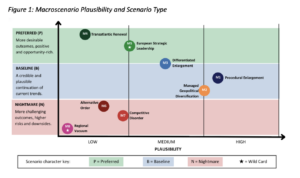
The eight macroscenarios fall into three groups according to the scenario types from which they predominantly emerged (Figure 1):
Baseline macroscenarios continue present trends:
- MS1 Procedural Enlargement. Funding, market access and infrastructure draw the candidate states into deeper integration with the EU, while accession advances slowly and unevenly. Montenegro joins around 2029–30, but elsewhere technical integration can continue without equivalent progress towards membership or domestic reform.
- MS2 Managed Geopolitical Diversification. Governments retain deep economic integration with the EU while maintaining relationships with other external actors in areas such as finance, infrastructure and security. These relationships remain compatible enough for candidate states to sustain them simultaneously. The EU remains the economic centre while its political leverage weakens.
- MS3 Differentiated Enlargement. Frontrunners join on merit while others integrate sector by sector, strengthening the link between reform and reward. The gap between leaders and laggards widens, but enlargement proceeds despite those differences.
Preferred macroscenarios consolidate an EU-centred order on different security foundations:
- MS4 Transatlantic Renewal. The USA re-engages strategically with a stronger EU, combining security guarantees with enlargement and deeper political alignment. Experts generally regarded such a renewal as a distant prospect.
- MS5 European Strategic Leadership. The USA steps back and Europe assumes greater responsibility for defence, military mobility, energy and critical resources. Greater European capacity reduces the scope for geopolitical hedging, although a more geopolitical EU can also become more transactional about domestic reform.
Adverse macroscenarios differ in what replaces a weakened EU-centred order:
- MS6 Alternative Order. As EU and US leverage weakens, other external actors acquire greater capacity to constrain candidate-state choices. Rather than a single alternative hierarchy, the more plausible form is a patchwork in which different actors predominate in particular countries or sectors.
- MS7 Competitive Disorder. All major external actors remain engaged but pursue increasingly incompatible goals, while the USA can systematically work against EU interests. Candidate states initially retain opportunities to manoeuvre between competing relationships, but hedging becomes harder to sustain as the demands attached to them conflict.
- MS8 Regional Vacuum. External actors become selectively engaged as crises elsewhere absorb their attention and resources, without any of them assuming wider responsibility for regional stability. External engagement becomes uneven and conflicts are managed inconsistently or not at all.
The adverse macroscenarios share one consequence. Conflicts become harder to contain, common rules lose force, and candidate states become more exposed to coercion and bilateral bargaining.
About the GEO-POWER-EU project
GEO-POWER-EU (Empowering the Geopolitical EU in the Eastern Neighbourhood and the Western Balkans) is a research project funded by the European Union under the Horizon Europe research and innovation program. It is carried out by 14 partner organizations across 12 countries (spanning EU member states, candidate countries in the Western Balkans, and Eastern Partnership nations), operating primarily across the academic, public policy think tank, and economic research sectors.
GEO-POWER-EU aims to empower the EU to manage security threats in its Eastern Partnership and the Western Balkans amidst a deteriorating geopolitical environment. The project’s primary ambition is to surpass current standards and develop a comprehensive EU strategy for these regions, utilising new and reformed policy instruments while considering the strategic ambitions of other geopolitical actors.
The project’s research aims to advance beyond the current state of the art by developing a new conceptual and policy framework using both quantitative and qualitative methods. Methodologically, GEO-POWER-EU leverages cutting-edge expertise from various disciplines, implementing a multi-stage plan grounded in a participatory and inclusive approach. This approach involves systematic engagement of researchers from third institutions, decision-makers, stakeholders, and citizens—including those from the regions under analysis—throughout the project cycle.
